When Teflon pans came out in 1961, they were a big improvement over iron skillets. They were much easier to cook with, as food
virtually slipped out of the pan with very little lost because of sticking the skillet. And cleanup was so much faster and easier.
Now, researchers at the University of Arkansas have made the material — also known as polytetrafluoroethylene (PTFE) — even less sticky. This development could not only be good news for all those gourmet chefs out there, but also makers of medical devices or manufacturers that need to reduce friction in moving parts. The researchers’ work may help machinery last longer and operate more efficiently, reports Phys.Org.
“Polytetrafluoroethylene is a big, scary word,” says Min Zou, an associate professor of mechanical engineering at the university who supervised the development. “What we’re talking about here is a material layer or coating — a film — that essentially does not stick and is hydrophobic, meaning it repels water.”
PTFE is a solid lubricant and is appealing to manufacturers because it performs well in high temperatures, has low maintenance costs, and is clean compared to liquids. Phys.Org explains its other advantages and recent attempts to improve its non-sticky qualities:
It has been used as a lubrication polymer for many years, and recently scientists and engineers have attempted to improve the material by incorporating nanoparticle ‘fillers’ that reduce wear on the material and thus extend its life. However, high concentrations of these nano-fillers have created a problem: while reducing wear, they have also increased the material’s ability to create friction.
“A great obstacle in micro- and nanocomposite films has been the inability to find a filler material that provides good wear resistance as well as a low coefficient of friction,” Zou says. But Zou and her team found the secret material that is tough, yet slippery: silica.
She and her graduate student assistant applied thin films of silica to stainless steel. Then they tested it with varying degrees of friction and wear resistance. They performed the same tests on a pure PTFE film and then on bare stainless steel.
The results showed that silica was the key new ingredient. “Micrographs revealed that the composite films with higher concentration of silica had much narrower wear tracks after the samples were subjected to rubbing tests,” Zou says.
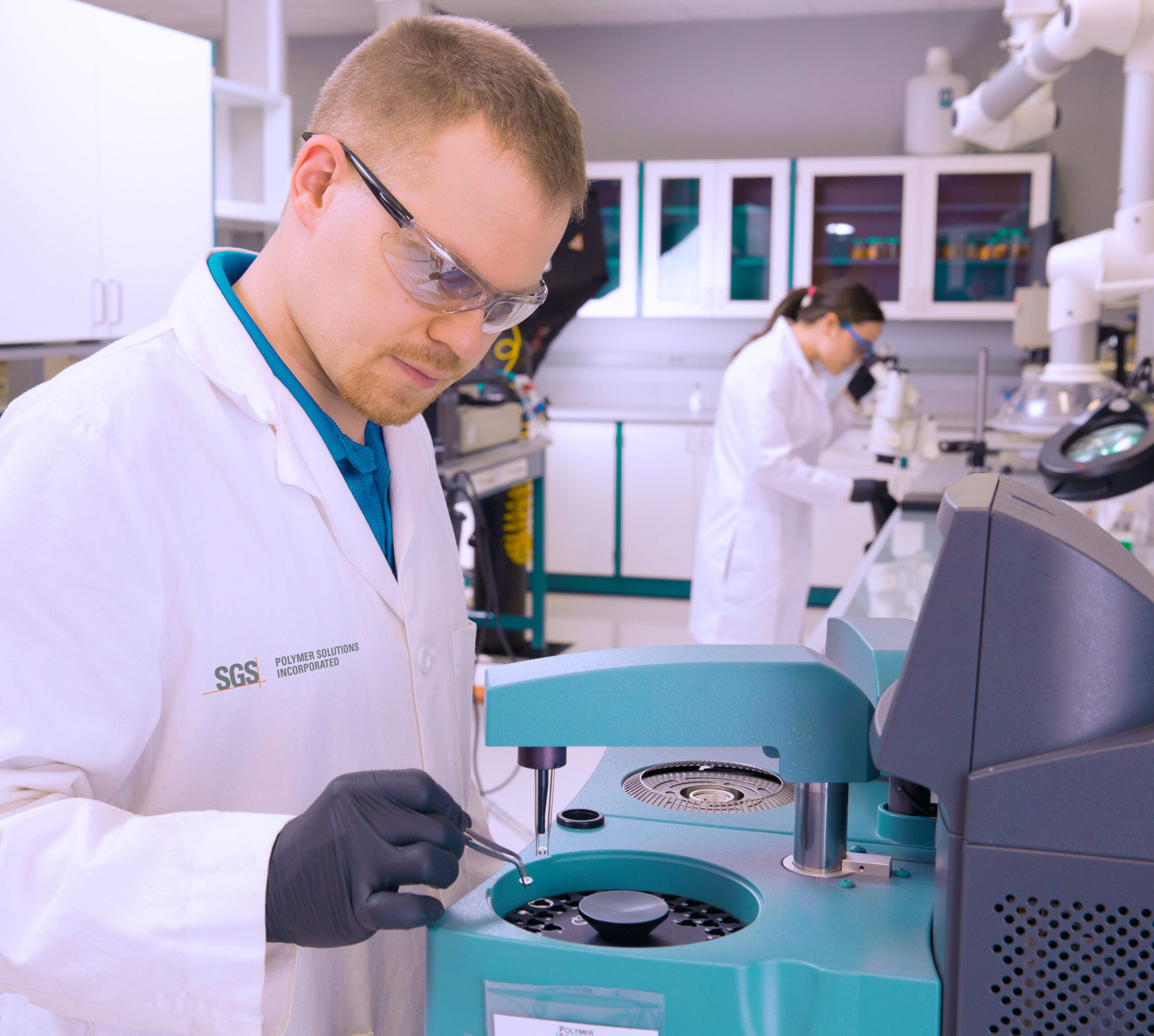
Polymer Solutions (PSI) is a full-service testing laboratory that can tell manufacturers the composition of various products made with polymers, plastics, and adhesives. Here is an example of what it does.
Source: “Research improves dry lubricant used in machinery and biomedical devices,” Phys.Org, 5/17/13
Image by Andrevan.
Standardization certificate ensures that laboratories that prepare testing and calibration reports have the procedures in place to consistently produce valid results. A prerequisite for a lab to earn a certification is to have a documented quality management system.
metathesis, a catalyst will enable a double-bonded atomic group to change places with another. It has long been possible to make new substances in these reactions, but not much was known how those catalysts function.
shrimp shells to conserve food wrapped in
We might be able to build tougher airplanes, stronger bridges, and harder body armor, thanks to the research conducted by
Canadian named Hannah Warren, may give regenerative medicine a huge boost. The surgery, which took nine hours at Children’s Hospital of Illinois in April, has occurred only six times. It was the first occurrence in the United States, and received approval from the U.S. Food and Drug Administration (FDA) under rules that allow experimental procedures when the patient has little chance of survival,
nanoparticles in
50 years ago, and Dow Chemical Company have teamed up to develop a system that they say can provide 
places where they can be catastrophic,” says bioengineer Jeffrey Karp, co-director of the Center for Regenerative Therapeutics at Brigham and Women’s Hospital in Boston, who is using the physical characteristics of a spiny-headed parasitic worm to make better adhesives. Bandages have a hard time staying on wet, oozing wounds.