Polymer Solutions

  • Thermal Analysis

    Melt Flow Index Testing (MFI)

    Melt Flow Index is an analysis method that determines the ease of flow of plastic materials.

    Read More

  • Thermal Analysis

    Differential Scanning Calorimetry Testing

    Differential Scanning Calorimetry (DSC) polymer analysis and plastic analysis measures the heat capacity of a sample.

    Read More

  • Metals Testing Microscopy

    Scanning Electron Microscopy (SEM) Services

    Scanning Electron Microscopy provides high resolution micrographs of the morphology or topography of a specimen, with great depth of field at very low or very high magnifications.

    Read More

  • Chromatography Metals Testing Thermal Analysis

    HPLC Testing | High Performance Liquid Chromatography

    Molecules in solution are separated based on interactions with the stationary phase and are detected using a variety of methods.

    Read More

  • Spectroscopy

    Fourier Transform Infrared Spectroscopy (FTIR)

    The chemical composition of a location the size of one-tenth the period at the end of this sentence can be determined using the FTIR spectrometer together with the external microscope accessory.

    Read More

  • Physical Testing

    Custom Fixture Development

    We can provide custom and validated testing fixtures, entirely based on the needs of your project.

    Read More

  • Metals Testing Physical Testing

    Compression Testing

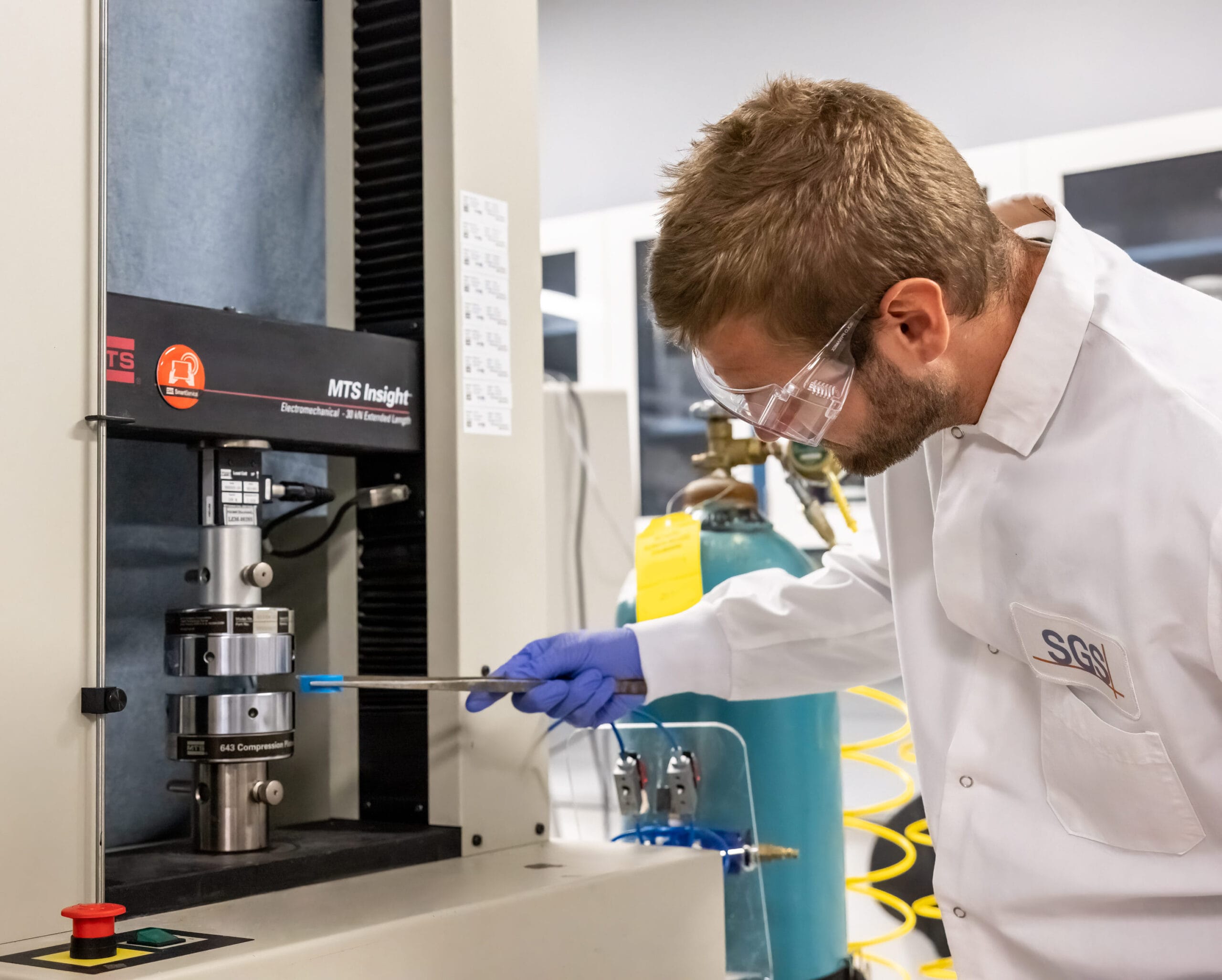
    When the response of a material or product to being “pressed” or “pushed on” needs to be determined, compression tests are used.

    Read More

  • Metals Testing Physical Testing

    Flexural Testing

    This physical testing method can be used to ensure product specifications, as a means of quality control, and can be used in material development.

    Read More

  • Metals Testing Physical Testing

    Tensile Testing

    Tensile testing provides information on the strength of a material and the amount it will elongate, as tension is created through the application of force.

    Read More

  • Physical Testing

    Specific Gravity & Density Determination

    Specific gravity and density testing is often used for quality control measures.

    Read More

  • Physical Testing

    Durometer Testing

    Durometer testing is a physical test method that provides information on the hardness of rubber and plastic materials.

    Read More

  • Metals Testing Spectroscopy

    X-ray Photoelectron Spectroscopy

    XPS is a quantitative spectroscopic technique that can be used to analyze the surface chemistry of a material in its "as received" state.

    Read More

  • Metals Testing Spectroscopy

    Inductively Coupled Plasma Analysis (ICP)

    ICP/OES is an analytical technique used for the detection of trace metals.

    Read More

  • Spectroscopy

    Auger Electron Spectroscopy Analysis

    Auger Spectroscopy Analysis (AES) is a widely used surface analysis technique that has been successfully applied to many diverse fields.  AES is an excellent tool…

    Read More

  • Chromatography

    Gas Chromatography-Mass Spectrometry Services

    GC/MS links the analytical capabilities of Gas Chromatography and Mass Spectrometry to separate and then identify different substances within a sample.

    Read More

  • Chromatography Spectroscopy

    Size Exclusion Chromatography/ Gel Permeation Chromatography

    Size Exclusion Chromatography and Gel Permeation Chromatography are often used interchangeably. This form of liquid chromatography analysis separates molecules based on size.

    Read More

  • Titrations

    Halide Testing

    Ion-selective electrodes quantify the levels of halide ions in solution. Halide ions include fluoride, chloride, bromide, and iodide.

    Read More

  • Titrations

    Karl Fischer Titrations

    Karl Fischer Titrations give specific and sensitive quantitation of the water content of samples.

    Read More

  • Titrations

    Potentiometric Titrations

    Any normal acid-base titration can also be done potentiometrically, where a pH probe is used to make a plot of pH vs. titrant volume added.

    Read More

  • Wet Chemistry

    Chemical & Thermal Digestion

    Dissolution of sample matrix with either strong acids or bases, or high temperatures.

    Read More

  • Thermal Analysis

    Rheology Testing

    Rheology is a thermal test method that measures the melt viscosity, creep, and stress relaxation responses of polymers as functions of time, temperature, and force.

    Read More

  • Wet Chemistry

    Dilute Solution Viscosity

    DSV is a key test method for polymer characterization. By measuring the flow time of a polymer solution through a precision capillary, we can measure the viscosity. This relates to molecular weight.

    Read More

  • Spectroscopy

    Nuclear Magnetic Resonance Spectroscopy (NMR)

    NMR is a quantitative technique for analyzing materials to determine the organic chemical components of a sample.

    Read More

  • Wet Chemistry

    Solvent Extractions

    Solvent extraction uses selected solvents to remove additives, stabilizers, low molecular weight ingredients, and other soluble components from within a polymer system.

    Read More

  • Thermal Analysis

    Dynamic Mechanical Analysis (DMA)

    DMA also known as Dynamic Mechanical Thermal Analysis (DMTA), is a method of analysis that determines the mechanical properties of a sample as a function of temperature and frequency simultaneously.

    Read More

  • Thermal Analysis

    Thermogravimetric Analysis (TGA)

    TGA continuously monitors the mass of a sample during isothermal or dynamic temperature scans in an air, nitrogen, oxygen, or specialty atmosphere. The resulting graph of mass versus temperature reveals the evaporation of materials, decomposition of polymers, and the presence of fillers and carbon black.

    Read More

  • Chromatography

    Gas Chromatography-Analysis Lab

    Gas Chromatography (GC) is an analytical method that separates a mixture of molecules into individual chemicals and then determines the amount of each chemical.

    Read More

  • Metals Testing Microscopy

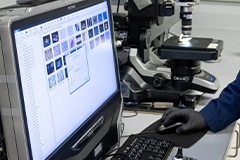
    Microscopy Image Analysis

    Our scientists take measurements of images captured with various microscopy techniques and perform statistical analysis, using software programs, based on those measurements.

    Read More

  • Metals Testing Microscopy

    Transmission Electron Microscopy Testing (TEM)

    The TEM is capable of examining single columns of atoms at magnifications that exceed optical microscopy (OM) by tens of thousands of times.

    Read More

  • Microscopy

    Atomic Force Microscopy (AFM)

    AFM is an analytical tool used to measure differences in modulus and height of materials in the nanoscale size range.

    Read More

  • Microscopy

    Optical Birefringence Analysis

    Optical birefringence provides an image with spaced colored zones that relates to the stress distribution that exists within the sample that is positioned between light polarizers.

    Read More

  • Metals Testing Microscopy

    Optical Microscopy Analysis

    Optical Microscopy Analysis uses a system of lenses and visible light to magnify the image of a sample.

    Read More

  • Chromatography

    Headspace Gas Chromatography/ Mass Spectrometry

    A specific Gas Chromatography/Mass Spectrometry technique used to identify and/or quantify volatile organic compounds (VOC’s) present in the injected headspace sample.

    Read More

  • Metals Testing Spectroscopy

    Energy Dispersive Spectroscopy

    Our Energy Dispersive Spectrometer is used in conjunction with our Scanning Electron Microscope to provide elemental composition and mapping of a sample.

    Read More

  • Chromatography Microscopy Physical Testing Spectroscopy Titrations Thermal Analysis Wet Chemistry

    Polymer Analysis

    The use of polymers is so pervasive that nearly all industries have a need for polymer analysis either regularly or on an as-needed basis.

    Read More

  • Chromatography

    Chromatography Testing Capabilities

    Chromatography testing methods are used to separate and identify complex mixtures.

    Read More

  • Physical Testing

    Physical Testing Methods

    These testing methods involve the measurement of physical characteristics of a material. They are especially useful for emulating how a product will behave when it is being used by the end user.

    Read More

  • Metals Testing

    Metallography Analysis

    Metallography is the study of the physical structure of metals, specifically the microstructure or other morphological features.

    Read More

  • Metals Testing

    Rockwell Hardness C & B

    This testing technique calculates the hardness of a metal by measuring the depth an indenter travels into a metal, after a known load is applied.

    Read More

  • Spectroscopy

    Spectroscopy Lab Services

    Spectroscopy is a class of tests which study the interaction of sample specimens with energy, usually in the form of light.

    Read More

  • Wet Chemistry

    Wet Chemistry Analysis

    Wet Chemistry, or Applied Chemistry, is often a necessary part of a testing program to dissolve, filter, extract, and isolate components of a sample for further testing.

    Read More

  • Microscopy

    Microscopy Analysis Services

    Microscopy methods are used to understand the size, shape, structure, and topography of materials and samples.

    Read More

  • Thermal Analysis

    Thermal Testing

    Thermal Analysis techniques measure the thermal transitions, chemical reactions, and viscoelastic properties of samples as a function of temperature, heating rate, deformation, and atmosphere.

    Read More

  • Microscopy Spectroscopy

    Scanning Electron Microscopy with Energy Dispersive Spectroscopy

    Elemental Mapping or Spectral Imaging can be used to colorize an image based on what elements are present at a specific pixel on the SEM micrograph.

    Read More

  • Spectroscopy

    UV-Vis Analysis

    UV-VIS testing is primarily used to determine the concentration of compounds that absorb radiation within the UV range of the electromagnetic spectra.

    Read More

  • Metals Testing Wet Chemistry

    Heavy Metal Limit Testing

    Heavy metal limit testing is used to screen products for harmful metals.

    Read More

  • Wet Chemistry

    PEEK Derivatization

    Polyether ether ketone (PEEK) is a very thermally and chemically resistant polymer and requires special preparation before testing.

    Read More

  • Metals Testing

    Metals Testing

    It is important to determine the ultimate properties of metallic materials to be able to understand the performace range of products and the reasonable expectations of establishing operating ranges.

    Read More

  • Wet Chemistry

    Brookfield Viscosity Testing

    Brookfield viscometry is a test of dynamic viscosity which involves a spinning shaft in contact with the fluid to be measured.

    Read More