
Chemical Analysis
Biobased Content Testing for Polymers, Plastics and Other Materials – Make Your “Biobased” Claims Accurate and Defensible
Biobased products are made wholly or partly from renewable biomass-derived materials, such as plants, algae, agricultural residues, and microbes. They offer a more sustainable alternative to petroleum-based products, matching performance while reducing reliance on fossil carbon.
Why is biobased testing necessary?
For marketing purposes, having a third-party proof of your “biobased” claims will make your product stand out from competition. Moreover, there are also ecolabeling and tax incentive programs that require and recommend biobased testing.
For example, the SGS Green Marks Biobased Certification for plastics require that the product be at least 30% total carbon based on dry mass and at least 20% biobased carbon as determined using the standard test methods ASTM D6686, EN 16640 or ISO 16620-2.
There are tax credit programs for manufacturers of substances sold or used to produce chemicals, polymers, and plastics in various US states. In Maine, manufacturers of materials with at least 95% biobased content as determined by ASTM D6866 testing may apply for tax credits. In Minnesota, renewable chemicals should at least be 51% biobased to get tax credits.
Biobased testing is also important in research and development as well as quality control and assurance. Knowing the exact biobased content of your product is significant for product characterization. Biobased testing allows you to validate your suppliers’ biobased claims.
How is biobased carbon measured?
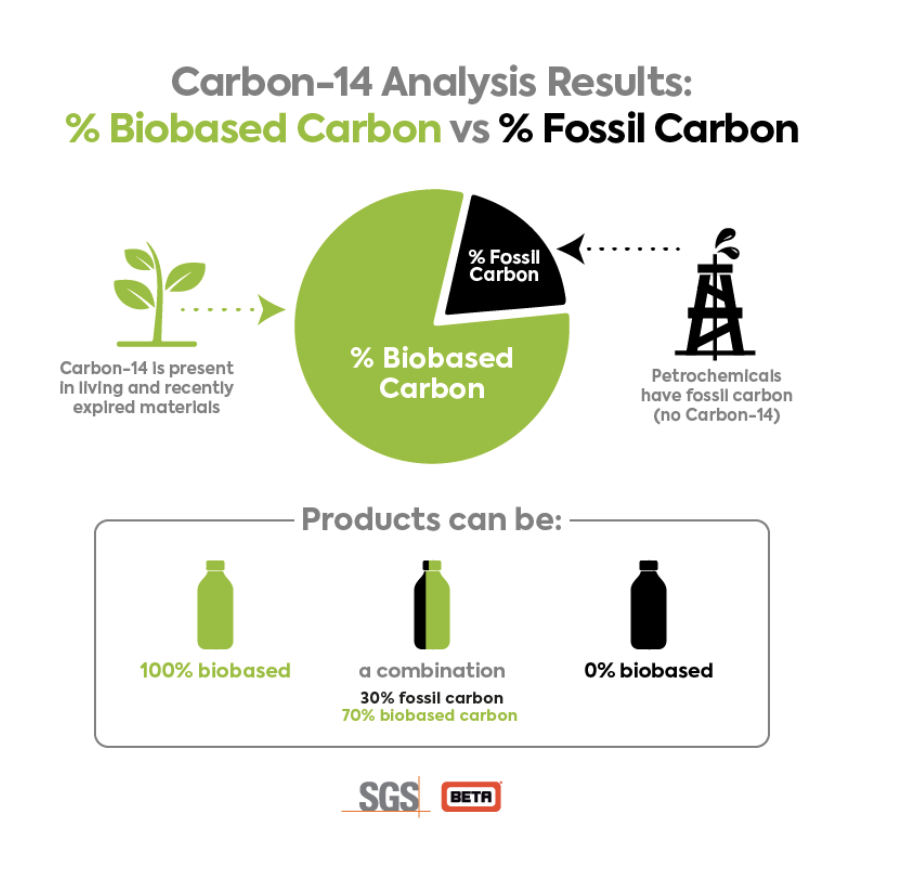
Through Carbon-14 analysis, the percentage of a material’s biobased carbon vs fossil carbon can be determined. Any carbon-containing material from biomass (e.g. plants) has a well-characterized amount of Carbon-14 while materials from petroleum-derived materials have no Carbon-14. A product solely made from plants is 100% biobased while a petrochemical product is 0% biobased (100% fossil carbon). Products with both biomass and fossil-based components will have a biobased percentage between 1%-99%.
Learn more about biobased content testing of various solids, liquids and gaseous materials in SGS Beta’s website.
Other Polymers and Plastics Testing Services
Wherever you operate, SGS Beta’s ISO/IEC 17025–accredited lab and expert scientists are ready to support your testing needs – backed by decades of experience and a comprehensive suite of capabilities.
Aside from Biobased Carbon Testing, SGS also provide these services, among others:
Discuss your specific sample requirements with a testing expert. Have questions or need a quote?